
Queering Paradigms 6 at CCCU: Videos of selected presentations from the second day, 24 July 2015.
Posted in News, QP6, Videos
Tagged Academics, Botswana, Church, Conference, Emilie Autumn, Homophobia, India, LGBT, LGBTIQ, Mental Health, Planet Romeo, Queer, Queer Feminism, Queer Nuns, Serious Parody, Sisters of Perpertual Indulgence, Social Media, Virtual
1 Comment
Transgender Day of Remembrance 2015
TDoR 20 November 2015, CCCU, U.K.


Organised by CCCq and the CCCU chaplaincy.
Closing address by Bee Scherer
Today is the 17th International Transgender Day of Remembrance.
As“Transrespect versus Transphobia Worldwide” (TvT), a research project of Transgender Europe, reminds us
TDoR started as a memorial to Rita Hester who was stabbed to death in her own apartment in San Francisco in 1998 within weeks from the notorious Matthew Shephard murder. TvT shares this depressing statistic:
These 271 human beings are only the tip of the iceberg, they contain only those whose murder has been reliably reported during the last year. They bring the total of reported trans murders to almost 2000 since 2008; and let us remind ourselves that 80% of those are trans women of colour.
Today we mourn them all. We mourn them together with the many more trans persons we have lost to self-harm and suicide. Their deaths are also murders and we all share in the responsibility. The unprecedented high amount of suicidality among trans persons correlates to the lived trans experience of often daily bullying, frequent threats and physical violence as well the constant systemic silencing and erasure of trans and gender-non binary voices.
Transphobia as I have argued in recent papers is heteropatriarchy’s and heterosexism’s strongest manifestation. We share in oppressive heteropatriarchy’s triumph of sexism, homo- and bi-phobia and transphobia because we do not speak up enough, do not reach out enough, fight enough, care enough. Sadly, some LGBs and some self-avowed feminists even actively contribute to the trans* marginalisation and hate speech. Make no mistake: hate speech kills just as much as hate acts. Through hate speech actions are encouraged and justified. Again in the last year transphobia has been given the odour of respectability by both religious leaders and secular thinkers. Remembering all those lost due to privileged bigotry, religious hate speech and the self-righteous violence our societies exerts and empowers we all share the burden of responsibility for the deaths of those we are mourning today.
In the face of our own small-mindedness and cowardice let us vow to celebrate human life in its messiness, its blurred categories and its unexpected, wonderful richness and complexity. Let us celebrate the memory of those lost: We are part of the net of their lives and deaths. Our names are called as both the victims and the perpetrators. As the Buddhist master Thich Nhat Hanh says in one of his most famous and powerful poems:
Please call me by my true names
So I can wake up
And so the door of my heart can be left open
The door of compassion.
Queering Paradigms 6 at CCCU: Videos of selected presentations from the first day, 23 July 2015.
Posted in QP6
Tagged Academic, Bee Scherer, Cancan, Cancer, Canterbury, Canterbury Christ Church University, CCCU, Confererence, Criminology, Disability, Ethics, Feminism, Healthcare, Lectures, LGBTIQ, Presentations, QP6, Queer Studies, Queer Theory, Queering Paradigms, Reproduction, Suicide, Videos
Leave a comment
Long-standing QP activist Dr Leonardo Raznovich faced with the possibility of deportation from the Caymans
https://caymannewsservice.com/2015/09/same-sex-couple-plan-immigration-challenge/
http://www.compasscayman.com/caycompass/2015/09/03/Gay-couple-challenge-Immigration-decision/
http://www.caymanreporter.com/2015/09/03/law-professor-mount-gay-marriage-immigration-appeal/
Dr Leonardo Raznovich, a prominent QPer of the first hour, is faced with the possibility of deportation from the Caymans, since an application filed by his 16 year partner, Dr James Reeve with whom he is married and also has a civil partnership, to add Dr Raznovich as his spouse and therefore a ‘dependant’ to his work permit, as any heterosexual married couple may do, has been rejected by the Immigration Authority. The Authority has declined to recognise their marriage or their civil partnership even though last year they recognised a polygamous marriage for the purpose of determining the legitimacy of the couple’s children for inheritance purposes Shiu Pak Nin v HSBC International Trustee Limited (11 February 2014) (1) CILR 173 [para 119].
Despite the Cayman Islands being a British Overseas Territory, meaning Caymanians in many ways are treated as British, including rights to UK passports and free movement to live and work in the UK and EU and to receive welfare benefits, the territory does not have any legal framework in place for the protection of LGBT people.
Earlier this year Dr Leonardo Raznovich helped students of the Truman Bodden law School, a government entity, to organise a series of free public lectures in the Cayman Islands last January about “Misogyny and homophobia: What is the Cayman Islands doing to promote gender and LGBT equality?”
The lectures were a success with the auditorium packed (and Dr Raznovich was asked to repeat his lecture for TED Talks https://youtu.be/zAwVSn5pCfk) but as a consequence of his ongoing support of the LGBT-themed series of lectures, the government did not renew his contract.
https://caymannewsservice.com/2015/07/hrc-calls-on-cig-to-legalise-gay-unions/
LGBT people in the Cayman Islands, whether visiting or living there, face discrimination from private and public authorities and there is no legal framework to protect them.
Dr Raznovich and Dr Reeve are having to fight for the right to remain together on the island at great cost and despite the very clear breaches of their human rights. The Foreign Commonwealth Office of the UK (with jurisdiction over the Cayman Islands) and the Office of the Premier of the Cayman Islands have not issued any statement yet.
UPDATE 10 September 2015:
http://www.pinknews.co.uk/2015/09/10/cayman-islands-anti-gay-laws-to-be-challenged-in-court/
Posted in News
Tagged Academic, Activism, Caymans, immigration inequality, Leonardo Raznovich, marriage equality, News
Leave a comment
#QP5 organizer assaulted; awaiting #deportation from #Ecuador – #IndigenousRights #QueerActivism
QP5 co-organizer Dr. Manuela Picq (a French-Brazilian national) appears to have been violently assaulted and incurred head injuries from batons (Ecuadorean Spanish: tolete) during the recent indigenous rights protests in Quito. Now she is threatened by deportation.
If you read Spanish here is yesterday’s news story:
http://www.elcomercio.com/…/periodista-francesa-manuela-pic…
Watch this space for updates if there is anything we as international Queer Studies and Activist Community can do to help Manuela.
Posted in News, QP5
Tagged Activism, Ecuador, Indigenous Rights, Manuela Picq, News, Newspaper, QP, QP5
Leave a comment
QP6: Preliminary Programme at CCCU, 23-24 July 2015
Queering Paradigms 6
ETHICS BEYOND TROUBLING: TOWARDS QUEER(ED) (VARI)ABILITY
Programme at Canterbury Christ Church University, U.K.
23 – 24 July 2015
Location: Powell, ground floor Pg09 (North Holmes Road Campus)
Thursday, 23 July 2015
8:45am Registration, distribution of conference packs for presenters
9am Welcome by Keith McLay (Dean of Arts and Humanities; Senior Management Team Member responsible for the Arts, Culture and Sports)
Session: Queer Ethics: Readings and Applications
Chair: Shane Blackman (Canterbury Christ Church University)
Will Visconti, Constructing La Goulue: the Queer, the Criminal, and the Cancan
Bojan Koltaj (Canterbury Christ Church University), Žižek’s political theology of the Neighbour as Queer ethics?
John Gilmore (Canterbury Christ Church University), Queer Expressions: Sexuality in daily healthcare
(Break ca. 11-11:30am)
11:30am VariAbilit(ies) II @ QP6: Variability, sexuality and “The Remuant”
Chair: Bee Scherer (Canterbury Christ Church University)
Chris Mounsey, The Limits of Knowing the Variable Body
Emile Bojesen, Queer Pedagogy for a Remuant Existence
Lunch break (ca. 1-2:30pm)
2:30pm Afternoon Session: Narratives and Theories
Chair: Janet Melville-Wiseman (Canterbury Christ Church University)
Matt Ball, The Ethics of Queer/ing Criminology: The Case of the ‘Prison of Love’
Paula Kuzbit (Canterbury Christ Church University), Queering Cancer Narratives
(Break ca. 3:30-4pm)
Ian Marsh (Canterbury Christ Church University), Queering Suicidology: The Challenge of Ontological Differences within a (fairly unreflective) Disciplinary Field
Doris Leibetseder, Reproductive Ethics: an example of an allied dis/ability-queer-feminist justice
5:30pm Optional excursion: Canterbury Cathedral Evensong
8:30pm Queering Paradigms 6 PARTY! LGBT night at the Two Sawyers pub
(58 Ivy Lane, near CCCU)
Friday, 24 July 2015
8:30am Coffee and Tea offered by CCCq, the LGBTIQ+ staff network of CCCU
9am Welcome by Tony Lavender (Pro-VC, representing the Vice-Chancellor and SMT responsible for research; and Equality & Diversity)
Keynote Panel: Queered Religion Chair: Bee Scherer
Carol S. Anderson (Kalamazoo College), Regulating Physical Bodies in Pali Buddhist Texts
Melissa M. Wilcox (Whitman College), Sincerest Form of Flattery? Serious Parody and Twenty-First Century Queer Nuns
(Break ca. 11-11:30am)
Session: Glocal [global-local] Queer
Part I South Asia. Chair: Carol S. Anderson
Rohit Dasgupta, Virtual intimacies on digital queer platforms: Notes from India
Lorena Arocha, Queer and Trafficking: Positionalities, visibility and strategies among grassroot organisations in South Asia
Lhamu Tsering Dukpa, Understanding the Third: a study of the Hijras of Siliguri
Lunch break (ca. 1-2:30pm)
2:30pm Session: Glocal [global-local] Queer (continued)
Part II Chair: Leonardo Raznovich
Pulane E. Motswapong, The role of the Church in propagating homophobia in Botswana: An investigation
Tshenolo Jennifer Moenga, The Ethics of Heteronormativity in Botswana and its Impact on Homosexuality
Katharina Wiedlack and Masha Neufeld, Lynchpin for Value Negotiation: lesbians, gays and transgender between Russia and „the West“
(Break ca. 4-4:30pm)
Part III Chair: Declan Kavanagh
Rafael Garrido Alvarez, Violence against LGBTQ people in Quito, 2008-2013
Leonardo Raznovich, “Hate follows fear; and plotted ruin [follows] hate.” LGBT life and rights in the Caribbean.
Bex Harper, ‘Fight like a Girl’ in the Abusive Asylum: Emilie Autumn’s Queer-Feminist and Mental Health Activism
6-7pm Evening Wine Reception hosted by David Grummitt (Head of the School of Humanities)
Enquiries: Contact Bee Scherer, b.scherer@canterbury.ac.uk
Posted in News, QP6
Tagged Academic, Canterbury, Canterbury Christ Church University, CCCU, Confererence, LGBT, LGBTIQ, News, programme, QP6, Queer, Queer Studies, Queer Theory, Queering Paradigms, Queering Paradigms 6
Leave a comment
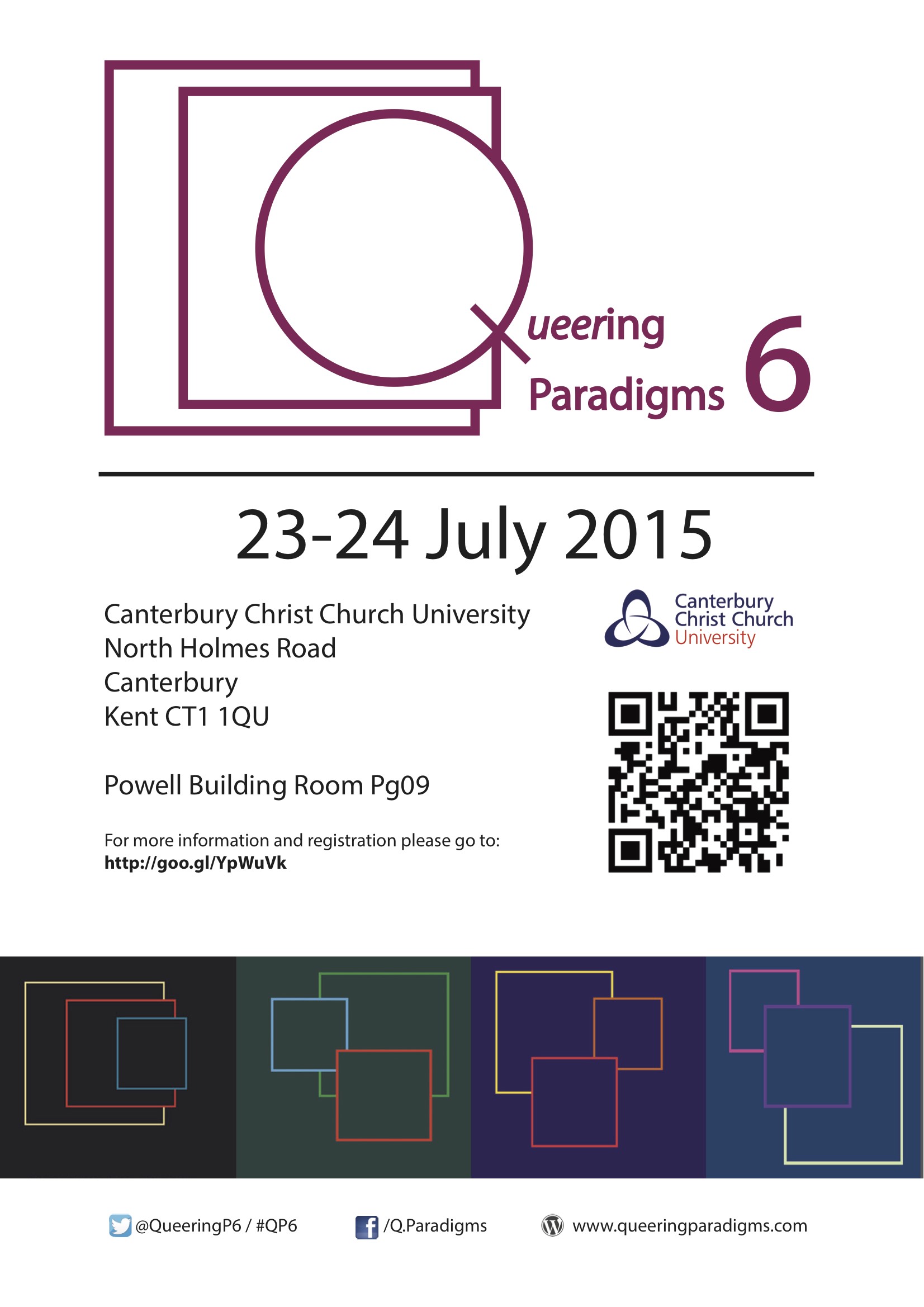
Poster for QP6 in Canterbury 23-24 July 2015
Posted in News, QP6
Tagged Canterbury, Canterbury Christ Church University, Confererence, LGBT, LGBTIQ, Poster, QP6, Queer, Queering Paradigms 6
Leave a comment
Upcoming QP 6
Dear QPers and friends!
Upcoming Queering Paradigms 6, (Winchester and) Canterbury, (20-21 and) 23-25 July 2015: Registration
QP6 is approaching fast; you can register your attendance at Queering Paradigms 6 via the conference website here.
Registration is free for the Canterbury part of the conference.
The information from the registration form will allow us here at Canterbury Christ Church University to better plan for your time with us during the conference.
The updated site also contains information about accommodation on offer at CCCU which may be booked directly with our accommodation office, quoting Queering Paradigms to avail of the special rate.
Programme including Emerging scholars’ day at the University of Kent
We will have an exciting QP programme:
| Thursday, 23 July | focus on Queer/Variabilities |
| Friday, 24 July | focus on Global Queer |
| Saturday, 25 July | Emerging scholars’ day @UKC |
More to follow.
NB: Thanks to the University of Kent at Canterbury‘s Centre for Gender, Sexuality and Writing we will also be offering a lovely (half) QP day on Saturday 25 July for emerging scholars, consisting of a workshop session and a round table giving us all the opportunity to learn from each other in terms of methodology, career trajectory and interdisciplinary work in practice. This event is organised by Dr. Declan Kavanagh; if you want to be part of it, please let him know (d.kavanagh[at]kent.ac.uk).
QP6 at VariAbilities II in Winchester
If you intend to join us in Winchester at QP6@Variabilities II, please make sure you register for this Winchester part of QP6 / VII (20-21 July 2015) separately.
The University of Winchester web store, where you register for the conference and book accommodation, can be found here.
The VII programme still in draft can be found here.
Posted in News, QP6
Tagged Academic, Activism, Canterbury, Canterbury Christ Church University, CCCU, Confererence, LGBT, LGBTIQ, News, QP, QP6, Queer, Queer Studies, Queer Theory, Queering Paradigms, Scholar, Social Justice, UKC, University of Kent, University of Winchester, UoK, Variabilities, Winchester
Leave a comment
Queering Paradigms: From Individual Resistance to Global-Local Impact
Originally published at E-International Relations on 23 February 2015
By Bee Scherer
Personal Beginnings
The global social justice academic network Queering Paradigms arose from civic defiance to local discrimination. In 2007, as a queer scholar, I felt the need to step up my engagement in social justice activism when my own employer, a Church of England founded university, tried to implement homophobic regulations, which clearly contradicted the institution’s then existing equality policies (and which today, after the Equality Act 2010, would be unlawful in the U.K.). I have described the more technical details of these academic-activist origins in an interview for the Brazilian Association for Applied Linguistics (ALAB) in 2012. Reflecting auto-ethnographically on the events, I note that conflicting emotions accompanied my decision to take a visible stance. On the one hand, I felt betrayed by the very institution which I had served conscientiously and enthusiastically in multiple functions, by always looking for participation and pushing for change. Still, I was not completely surprised, since I had witnessed on occasions how special protection used to be afforded to fundamentalist Christians on campus. And unfortunately I had myself been on the receiving end of homophobia at work. But bullying aside, I had always stood my ground and worked for change in the university’s Equal Opportunity Committee until a robust Equality Scheme was implemented; all our work seemed challenged in 2007. Oscillating between despondency and disobedience I opted for a different route: academic activism. From a first local queer studies colloquium (2008), a series of international queer conferences developed operating under a distinct ethos and vision: Queer Theory inseparable from applied and intersectional Queer Activism.
Queer
At the core of this approach is an understanding of ‘queer’ as proposed by Queer Theorists such as Eve Kosofsky Sedgwick and Judith Butler. Contrary to popular usage the ‘queer’ of Queer Theory is not simply a synonym for any Lesbian, Gay, Bisexual, Transgender, Intersex and Questioning/Queer (LGBTIQ) person (see the excellent short introduction into Queer Theory by Jonathan Kemp 2009). Instead ‘queer’ troubles the social hegemonic template of heterosexuality (‘compulsory heterosexuality’, heteronormativity, heteropatriarchy) and undermines essentialized/-izing assumptions of gender as a binary as merely either male or female (and thus eclipsing non-binary embodiments and performances) and of notions what such ‘male’ or ‘female’ categories normatively mean. ‘Queering paradigms’ as an interdisciplinary, social activism-centred approach presented envisions queerness as ‘ricochets’ (Querschläger): the resistance and defiance of people who leave the expected trajectory of heteronormativity suggesting that ‘to queer a paradigm’ means challenging the hetero-/homonormative and gender-binarist assumptions of any given academic discourse. Queer subjects defy the ‘seduction of identity by exclusion’ and celebrate ‘the whole potential of sexuality and gender fluidity and diversity’; they explode the limits of normative discourses and break new ground in research and activism for social change (Scherer 2010: 1-2; see also Ball and Scherer 2011: 1).
QP Ethos
Queering Paradigms (QP), both the conference series and the network, functions not only as a platform for queer/counter-heteropatriarchal emancipation; QP also poses a challenge to neoliberal academia itself, providing against a fiercely competitive academic context a genial and supportive environment of co-learning and co-creating for both established and emerging scholars. After the first international conference, with its single-stream panels and intense workshops and discussion, a distinct vision emerged of an itinerant, transdisciplinary glocal (global-local) conference series travelling annually from continent to continent with always changing local agency, emphases and impacts. Thus non-local participants find themselves challenged by new contexts and cultural conditions, while the specific activist agenda is set solely by the local organisers and determined by local needs: the sense of grass-root ownership without any imposed (colonial) agenda is crucial to QP.
Changing Policies, Changing Awareness
At its early beginnings in the South of England, QP already contributed to policy changes at Higher Education Institutes (HEIs)/universities. Through persistent prompting and co-creating, my own institution can now pride itself of one of the most progressive LGBTIQ related policies and practices in Higher Education and functions as an example to other HEIs in the UK and even the US. Following on a conference series manifested in a flow of linked and mutating intersectional foci and discourses (see Scherer 2015). All subsequent QP conferences achieved notable global impact: Brisbane 2010; Oneonta, New York 2011; Rio de Janeiro 2012; and Quito (2012 colloquium and) 2014. For example, QP2 in Brisbane prominently contributed to LGBT right’s debates in Australia. Retired Australian High court justice Michael Kirby delivered a keynote address, in which he emphasised the necessity of policy changes to secure full equality for all citizens. Kirby evoked the example of Australia’s colonial past and the ongoing need to revise and abolish colonial laws in line with social justice advances. Commenting on the ongoing debate Kirby positioned himself firmly by stating that ‘Legislation that does not allow gay marriage is unacceptable’. These comments were widely reported in the Australian national and local media (including the Brisbane Times and ABC, Brisbane and The Australian and The Age). The network has attracted increasing attention and recognition by local and national policy makers; the Brazilian government provided extensive funding to QP4 in Rio de Janeiro thus ensuring the presence of many of the currently famous North American Queer Theory scholars. This influx of dominating North American voices raised the standing of queer research and activist discourses in Brazil significantly. However, of course, the presence of a privileged elite brought with it its own neoliberal and colonial challenges that the local organisers had to negotiate: the high rope act of mediating between high visibility of the regional and South American voices and the politically necessary utilisation of neoliberal academic ‘stars’ (in some cases: ‘divas’) provided a valuable learning experience in system subversion through ‘playing the system.’ The following QP Quito colloquium carried the QP momentum in the Andean region and attracted high profile political support. Opened by the then Health Minister Carina Vance Mafla herself, the colloquium presented a prominent platform for national/regional political discussions, for instance around the illegal lesbian cure clinics in Ecuador.
Empowering Activists
The strong support for and presence of activists, artists and politicians from High Court Judges (Australia), African and South American LGBT leaders and artists (USA, Brazil), and government ministers (Quito) further exemplifies QPs impact on societal and policy debates. As a grass-root movement raising societal awareness and pushing for change, the QP impulse snowballs by giving voice to activists and empowering them. To give just two examples, in 2011, QP3 empowered West African activists in their work and search for funding; and after attending QP4, an Argentinean Anarcho-queer activist organised a QP empowering workshop in August 2012 for the local activists in Buenos Aires. There are many personal testimonies how QP has been influencing the next generation of queer academics/activists in their local/regional/national work for social justice. In one particularly moving example, a young Brazilian LGBT activists recollects her QP experience and how she felt inspired to fight against homo-and transphobia at universities in Rio de Janeiro in 2012:
[At QPIV,] I met B and we had a conversation, from which I left with a different worldview. A conversation of hope that I regard as a “politico- philosophical “salvation, because I could finally see the horizon from my own life experience. B spoke about the challenges of gender transition, said how important it was for us to stand on issues that are dear to many people and how important it was to participate in conferences that allow these issues to be discussed and addressed from the perspective not only of academia but of different social fields. […]In that conversation I had with B[] I was able to see [..] a way through education and activism! Three months after QPIV I [..] organized a major meeting at my university to discuss the problems and potential of trans identities , the name of the event was “For the UFRJ for everyone: LGBT identities in HE.” From there I went to [..] social activism for many trans people! We formed a sort of collective that seeks to combat homophobia, transphobia and lesbophobia in various spaces of UFRJ. I used the knowledge acquired in the QP to organize various round tables and debates on the subject of transsexuality. I was invited to give lectures to raise awareness [.]. I started to feel like a human being, a true citizen of otherness whose displacement is very powerful! (Translated from Portuguese; personal communication, 15 Oct 2013)
Challenging Gay Complacency
The impact of QP activities through raising awareness and changing attitudes extends also to the segments of the LGBT community, which are seemingly content with the niche afforded to them by the hegemonic heteropatriarchal discourse. One example is linked to the direct challenge to complacent ‘homonormativity’ (LGBT assimilationism and complacency). In Germany, I published a provocative QP essay on ‘Queer’ in the mainstream Gay magazine Männer (issue January 2012), reprinted in abridged form at the leading German gay news forum, www.queer.de. It received within 3 days 73 comments from gay men, many of them assimilationists and hostile to the queer project; the ensuing discussions clearly evidence considerate awareness change and challenge to established patterns of thought (see, for example, this activist blog in response to my piece and its comments).
Concluding Remarks: Scholarship as Activism
Through its activities the QP network sustains an ongoing engagement with non-academic queer activists and artists, growing to 500 registered participants at QP4 in Rio 2012. In true line with ‘intersectionality’ (Crenshaw 1989) marginalised Global-South and subaltern perspectives are given much space and voice: QP research presenting challenging and innovative developments of queering from across a variety of academic disciplines and political spheres has been recognized as “… not only saying, but doing language, in order to give queers around the globe voices of their own.” (Strutt 2012). In 2015 QP returns with fresh focus to the Global North and to its birth place – a changed and more mature place with a new management and with many dedicated and transdisciplinary colleagues attuned to Social Justice activism. Shifting from colonialities, QP will focus on abilities as variabilities (not disabilities). Looking for pathways to a non-bodynormative ethics, Queering Paradigms 6 will itself queer the paradigm of academic gatherings and perform itself as a pilgrimage from one end of the old English pilgrims’ route to another, from Winchester to Canterbury. Hence saying and doing the same, performative scholarship as activism continues and promises further advances in Social Justice through raising and transforming awareness and changing policies. As a Buddhist I share the view of societal responsibility and action for alleviation of not only individual but also systemic suffering with many other Buddhists who are loosely associating themselves under the umbrella of the Socially Engaged Buddhism movement. Similarly I believe that as academics in the various fields engaging with cultures and societies we have an inevitable and strong responsibility to advance systemic Social Justice. We simply cannot opt out of activism; whether we like it or not, our roles will always intersect with advocacy and it is our responsibility to use our educational class privilege for effecting change, even if the resulting blurred identity performance appears awkward in the eyes of those peers who maintain the illusion of self-proclaimed outsider critical observers (see Scherer 2015). As responsible scholar-cum-activists we need to embrace our blurred and hybrid roles. Or, as formulated in my postscript to the forthcoming Queering Paradigms 5 volume:
Ethically, there is no ‘mere criticality’; there is always also societal responsibility – ‘caretaking’ if you want: advancing discourses in a way that empowers participants and enables them to transform systems of oppression and injustice. Queering Paradigms as applied, intersectional Queer Studies invites us to embrace the blurring of our roles and performances as scholar-cum-Social Justice activists. (Scherer 2015).
Queering Paradigms on the web
Print References
Ball, Matthew and Scherer, B. 2011. “Introduction: Queering Paradigms, Interrogating Agendas” in Queering Paradigms II: Interrogating Agendas. Oxford: Peter Lang, pp. 1-10.
Crenshaw, Kimberlé 1989. “Demarginalizing the Intersection of Race and Sex”. University of Chicago Legal Forum, pp. 139-167.
Scherer, B. 2010. “Introduction: Queering Paradigms” in Queering Paradigms. Oxford: Peter Lang, pp. 1-7.
Scherer, B. 2015 [forthc.]. “Queer scholars, activists, critics and caretakers: Notes on the genealogy, impact and aspiration of Queering Paradigms” in Maria A. Viteri and Manuela Picq (eds.). Queering Paradigms V: Queering Narratives of Modernity. Oxford: Peter Lang.
Posted in News, Paper
Tagged Academic, Activism, Bee Scherer, Confererence, Gay Complacency, Heteronormativity, Homonormativity, LGBT, LGBTIQ, QP, Queer, Queer Studies, Queer Theory, Queering Paradigms, Scholar, Social Justice
Leave a comment
Call for Papers Queering Paradigms 6 – Extended Deadline
SECOND CALL FOR PAPERS: Queering Paradigms 6
Deadline extension: New deadline 30 November 2014.
After an exciting and highly productive five year journey through four continents, the Queering Paradigms conference will visit its point of origin again in its sixth incarnation. Queering Paradigms 6 is planned to be held in South England 20-25 July 2015.
Queering the academic conference format, QP6 will be hosted at two places: at the University of Winchester and at the other end of the pilgrims’ way, at QP’s birth place at Canterbury Christ Church University. QP6 part-merges with VariAbilit(ies) II (questioning the dis/abled binary), organised by Chris Mounsey (chris.mounsey@winchester.ac.uk) to form a conference continuum, variably the “same only different”. A rest/sightseeing/travel day is included in the combined schedule:
| 20 July 2015 | VariAbilit(ies) II | University of Winchester | |
| 21 July 2015 | Queering Paradigms 6 | VariAbilit(ies) II | University of Winchester |
| 22 July 2015 | REST/TRAVEL/SIGHTSEEING DAY |
| 23 July 2015 | Queering Paradigms 6 | VariAbilit(ies) II | Canterbury Christ Church University |
| 24 July 2015 | Queering Paradigms 6 | Canterbury Christ Church University | |
| 25 July 2015 | Queering Paradigms 6: Emerging scholar’s day | Centre for Gender, Sexuality & Writing University of Kent at Canterbury |
The combined conferences focus on the main theme of
Ethics Beyond Troubling: Towards Queer(ed) (Vari)Ability.
The QP6 conference aims to establish a multidisciplinary and bi- (or multi)- locational discourse around the possibility, challenges and potential of Intersectional Post/Queer Ethics and Practices beyond subversion and troubling. In addition, papers from all disciplines and methodologies concerned with queer life, culture and practices will add to the multi-/trans-/inter-disciplinary workshop style discourse of listening and learning, which characterizes the QP project.
We invite submissions of proposals from all angles of queering; and in particular from the area of Post/Queer(ed) Ethics (Applied or Theoretical) intersecting with, troubling and transcending (paradigms in) Health, Psychology, Special Needs Education and Disability Studies. Further intersections could include age; race/ethnicity; socio-economic status; religion/faith/irreligion.
Paper (poster) abstracts and panel proposals are invited by 30 November 2014. Please send to Prof. B. Scherer, CCCU (b.scherer@canterbury.ac.uk). Paper abstracts should be around 300 words long and include an indication whether the paper is intended to be an original (unpublished and not under review) contribution to the QP6 book, to be published 2016 with Peter Lang, Oxford (containing 16-20 chapters). Full papers are expected to be submitted by 1 May 2015.
Posted in Call for Papers, QP6
Leave a comment



 Queering Paradigms